How to cash out USDC to your local currency
Updated August 6, 2026
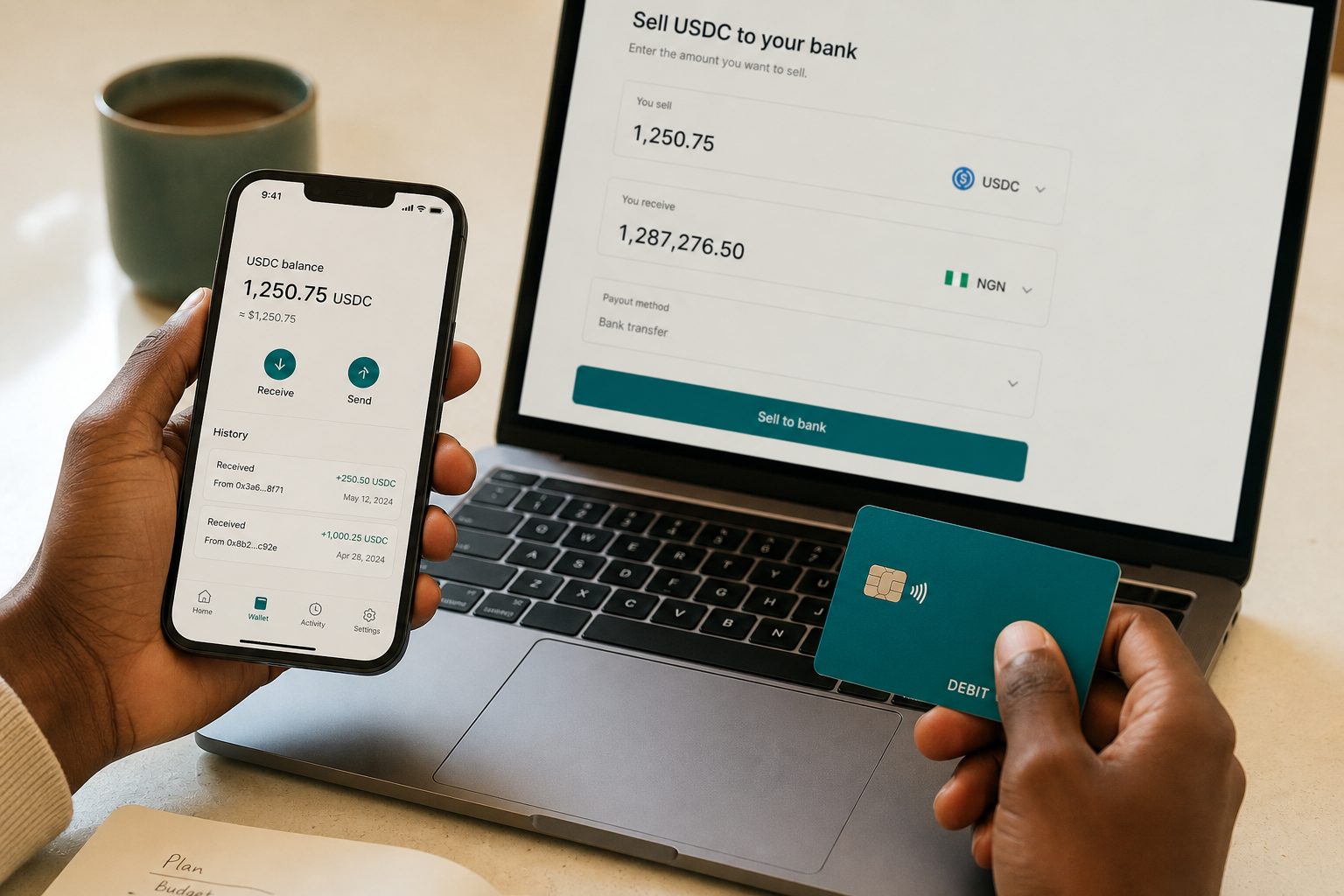
Cashing out USDC means moving your stablecoin balance to a centralized exchange, converting it to your local currency there, and withdrawing to a bank account or card, and each of those three steps carries its own fees, delays, and paperwork.
USDC itself doesn't touch your bank. It's a token that sits in a wallet or an exchange balance. To get local currency, you need a business willing to sell you fiat for it, which almost always means a licensed exchange or a fintech that has built a compliant off-ramp on top of one. If you got paid through something like the tip jar generator, the funds land in a wallet address you control, and nothing is custodied for you, so this whole process is entirely on your shoulders. That's the tradeoff of non-custodial tools: no one is holding your money, but no one is converting it for you either.
The three paths people actually use
Centralized exchange withdrawal is the default: send USDC to Coinbase, Kraken, Binance, or a regional exchange, sell it for your local currency, then withdraw to a linked bank account. Embedded off-ramp partners like MoonPay, Ramp, or Transak do something similar behind a simpler interface, often inside a wallet app, usually at a slightly worse rate. Peer-to-peer marketplaces, most visibly Binance P2P, let you sell directly to another person who pays your bank account, which matters in countries where direct bank rails to exchanges are thin or unreliable.
How exchange withdrawal actually works
You deposit USDC to your exchange account, matching the network it was sent on (Ethereum, Polygon, Solana, and Base are the common ones, and sending on the wrong network is the single most common way people lose funds permanently). You convert USDC to your fiat currency, which on most major exchanges is a 1:1 trade with no spread. Then you withdraw fiat through whatever local rail the exchange supports: ACH and wire in the US, Faster Payments in the UK, SEPA in the eurozone, PIX in Brazil, and so on. The whole thing typically takes anywhere from minutes to three business days depending on the rail you pick.
Fees to actually expect
Selling USDC for USD is free on Coinbase, and standard ACH withdrawal is also free, it just takes one to three business days. Faster same-day options cost more: Coinbase's instant cashout to a linked debit card runs about 1.5%, and wire withdrawals commonly run in the ten to twenty five dollar range depending on the exchange. Kraken charges a flat fee for wire withdrawals and reserves its fastest settlement tier for accounts with higher verification levels. SEPA Instant in the eurozone and Faster Payments in the UK are generally the cheapest same-day rails outside the US. None of this is exotic. It's the same fee logic as moving money between two regular bank accounts, just with a crypto step bolted on the front.
| Rail | Typical speed | Typical cost |
|---|---|---|
| ACH (US) | 1 to 3 business days | Free on most major exchanges |
| Wire (US) | Same day | Roughly $10 to $25 |
| SEPA / SEPA Instant (EU) | Minutes to 1 day | Low or free, varies by exchange |
| Faster Payments (UK) | Minutes | Low or free, varies by exchange |
| Instant debit card cashout | Minutes | Around 1.5% |
| P2P marketplace | Minutes to hours | Variable, set by the counterparty |
Availability depends heavily on where you live
This is the part people underestimate. A creator in the US or the eurozone can move USDC to a bank account in minutes for close to nothing. A creator elsewhere often can't do that at all through the same exchange. Bitso handles peso conversion well in Mexico with real local banking rails. Yellow Card, once a consumer app across several African markets, has shifted toward serving businesses rather than individual traders, so the retail on-ramp many creators used a couple of years ago isn't the same product now. Regulatory shifts can also close routes with little warning: Coinbase pulled its peso-based USDC on and off-ramp in Argentina less than a year after launching it. If you're getting paid from a platform like the Meta USDC payouts rollout, which pays creators through Stripe on Polygon or Solana starting from Colombia and the Philippines, the payout itself works the same everywhere, but what you can do with the USDC once it lands depends entirely on which exchanges and banking rails actually operate where you live. Check before you assume.
The KYC reality, plainly stated
You will be asked for a government-issued ID, and usually a selfie or short video match, before any exchange lets you withdraw fiat. This isn't optional and it isn't specific to crypto skepticism, it's the same anti-money-laundering framework that governs bank wires, now extended to virtual asset transfers. In the EU, the Transfer of Funds Regulation applies this to crypto transfers between licensed providers regardless of amount, and pushes extra verification, sometimes a signed wallet ownership check, on transfers above 1,000 euros involving a self-custodied wallet. In the US, banks and exchanges apply enhanced reporting above roughly $3,000. None of this is unique to any one exchange. Budget a day or two for identity verification if you're setting up a new account, longer if your documents need manual review, and expect withdrawal limits to be lower until you clear the higher verification tiers.
Site owners weighing whether to charge AI crawlers through Cloudflare's pay-or-block system and its x402 payment rail will eventually hit this same question, since any USDC collected there still has to go through an exchange to become spendable local currency. The mechanics described above apply the same way regardless of which side of the payment you're on.
Cashing out USDC is not a single action. It's a deposit, a conversion, and a withdrawal, each governed by a different set of rails, fees, and identity checks that vary by exchange and by country.
Quick answers
- How do I cash out USDC?
- Send USDC from your wallet to an exchange or payment app deposit, on the network that deposit screen names, then sell and withdraw to a bank.
- Can I cash out from the tip-jar address directly to a bank?
- Not usually. The jar receives tokens. A regulated off-ramp turns them into local currency.
- What is the usual mistake?
- Sending on the wrong network or skipping a memo/tag the exchange requires.