Wallet basics for creators who have never used crypto
Updated August 6, 2026
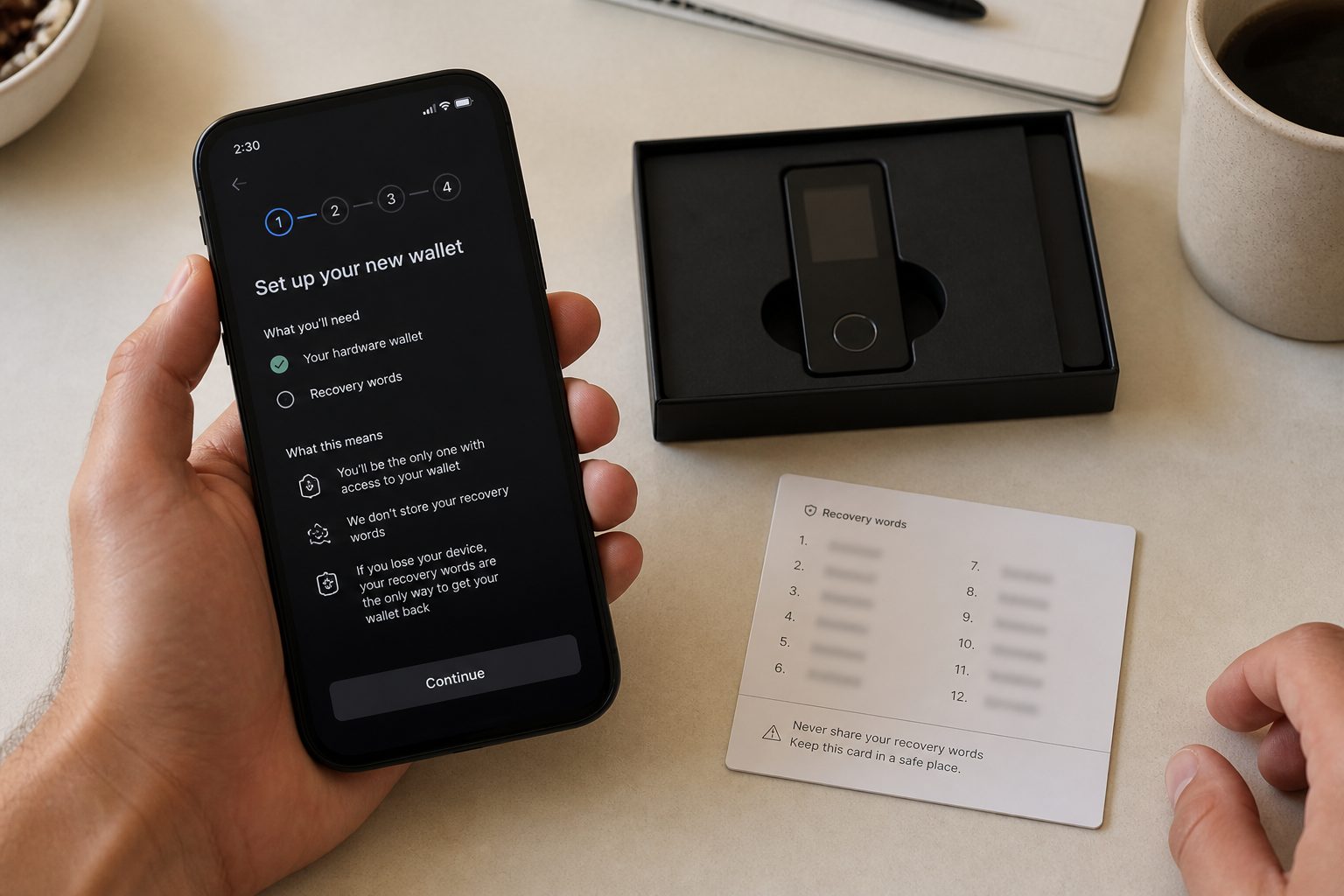
Most "get started with crypto" guides treat the wallet app as the decision. Pick the shiny one, done. The nuance almost nobody explains up front is that the app is the easy part. The real decision, the one that actually matters for a creator getting tipped in stablecoins, is whether an exchange holds your funds for you or whether you hold them yourself. Everything else, including which app you tap open, follows from that.
Custodial versus self-custody: pick this first
A custodial wallet is what you get when you sign up with an exchange like Coinbase or Kraken. You log in with a password, they hold the actual crypto, and if you forget your password there's a support team and an account recovery flow, much like any other online account. That convenience has a cost: the exchange can freeze withdrawals, get hacked, or in rare cases collapse with your funds tied up in the mess. It happened with FTX in 2022, and it's the reason "not your keys, not your coins" became a cliché in the first place.
A self-custody (or non-custodial) wallet works differently. Nobody controls it but you. There's no password reset, no support line, and no company standing between you and your funds. That's the appeal for a lot of creators taking tips directly, and it's the whole reason the tip jar generator is built the way it is: you paste in your own wallet address, the tool never touches or custodies anything, and payments land straight in a wallet only you control.
What a seed phrase actually is
When you set up a self-custody wallet, it hands you a list of 12 or 24 words, drawn from a standardized dictionary of 2,048 possible words. That's your seed phrase, sometimes called a recovery phrase. It isn't a password. A password gates access to an account that exists somewhere else. A seed phrase mathematically generates your wallet's private keys. It effectively is the wallet.
That distinction matters because of what happens when you lose it. There's no "forgot my seed phrase" link. No support agent can look you up and reset it. Nobody holds a master copy on a server somewhere, because that's the entire point of self-custody: no company is in the loop. Blockchain analytics firm Chainalysis has estimated that a striking share of all bitcoin ever mined, by some counts running into the millions of coins, sits in wallets whose owners lost access, mostly by losing their words rather than by getting hacked. Whatever the precise figure, the mechanism is the same one that would swallow a creator's tip earnings: write the words down wrong, store them in the wrong place, and they're gone for good. Nobody can help you after the fact.
A sane beginner setup
You don't need to overthink this to get it right. Write the seed phrase on paper (not a screenshot, not a notes app, not a cloud drive) the moment the wallet generates it. Keep two copies in two different physical locations. Never type it into a website, a support chat, or anything that isn't the wallet app itself during initial setup, since that's the single most common phishing trick in crypto. Send yourself a tiny test amount before you publish a payment link anywhere. This is a security habit, not a financial strategy, and it holds regardless of how much or how little you expect to receive.
For which app to use, three mobile wallets cover most creators' needs. The right pick depends on which network your tippers or platforms actually pay out on, which increasingly means Polygon or Solana rather than Ethereum itself. Meta, for instance, has been paying some creators in USDC via Stripe on Polygon and Solana since a rollout that began on April 29, 2026, as covered on the Meta USDC payouts page.
| Wallet | Best for | Chain coverage | Recovery beyond seed phrase |
|---|---|---|---|
| Coinbase Wallet | Beginners already on Coinbase; low-fee sends on Base | Ethereum, Base, Polygon, Solana, and others | Optional cloud backup, still seed-based underneath |
| MetaMask | Working across several Ethereum-style chains | Ethereum, Polygon, Base, Arbitrum, Optimism, Avalanche | Seed phrase only, no native Solana support |
| Phantom | Creators paid mainly in Solana USDC | Solana, Ethereum, Base, Polygon, Bitcoin | Seed phrase, plus some newer recovery options |
Network choice also changes what you pay to move money later. Sending USDC on Solana typically costs a fraction of a cent, Polygon runs somewhere around a cent, and Ethereum's own network can run several dollars per transfer, which is part of why creator payout rails keep steering toward the cheaper chains. That same math sits behind x402, the payment standard now backing Cloudflare's pay-per-crawl system described on the AI crawler payments page. It settles in stablecoins too, so the wallet habits covered here carry straight over if you ever end up charging bots as well as human tippers.
What stays true, what might not
Six months from now, the core mechanics here won't have moved. Self-custody will still mean full responsibility and no support line. A seed phrase will still be the actual key rather than a password standing in for one, and losing it will still mean losing the funds, permanently, with no exceptions. What's more likely to shift is the tooling wrapped around that reality: wallets keep experimenting with passkeys, multi-party recovery, and other ways to soften the all-or-nothing sting of a lost phrase, and whichever app counts as "the beginner pick" will keep changing as fees and chain support do too. Learn the underlying model now, and you won't need to relearn it every time an app redesigns its onboarding screen.
Quick answers
- What is a crypto wallet?
- Software or a device that holds keys. The app is the window. The seed phrase is the actual wallet.
- Custodial vs self-custody?
- Custodial means a company holds the keys (an exchange). Self-custody means you do, and nobody can reset the password.
- What happens if I lose the seed phrase?
- The funds are gone. There is no support line that can restore a self-custody wallet without those words.