Is USDC safe? What actually backs it
Updated September 25, 2026
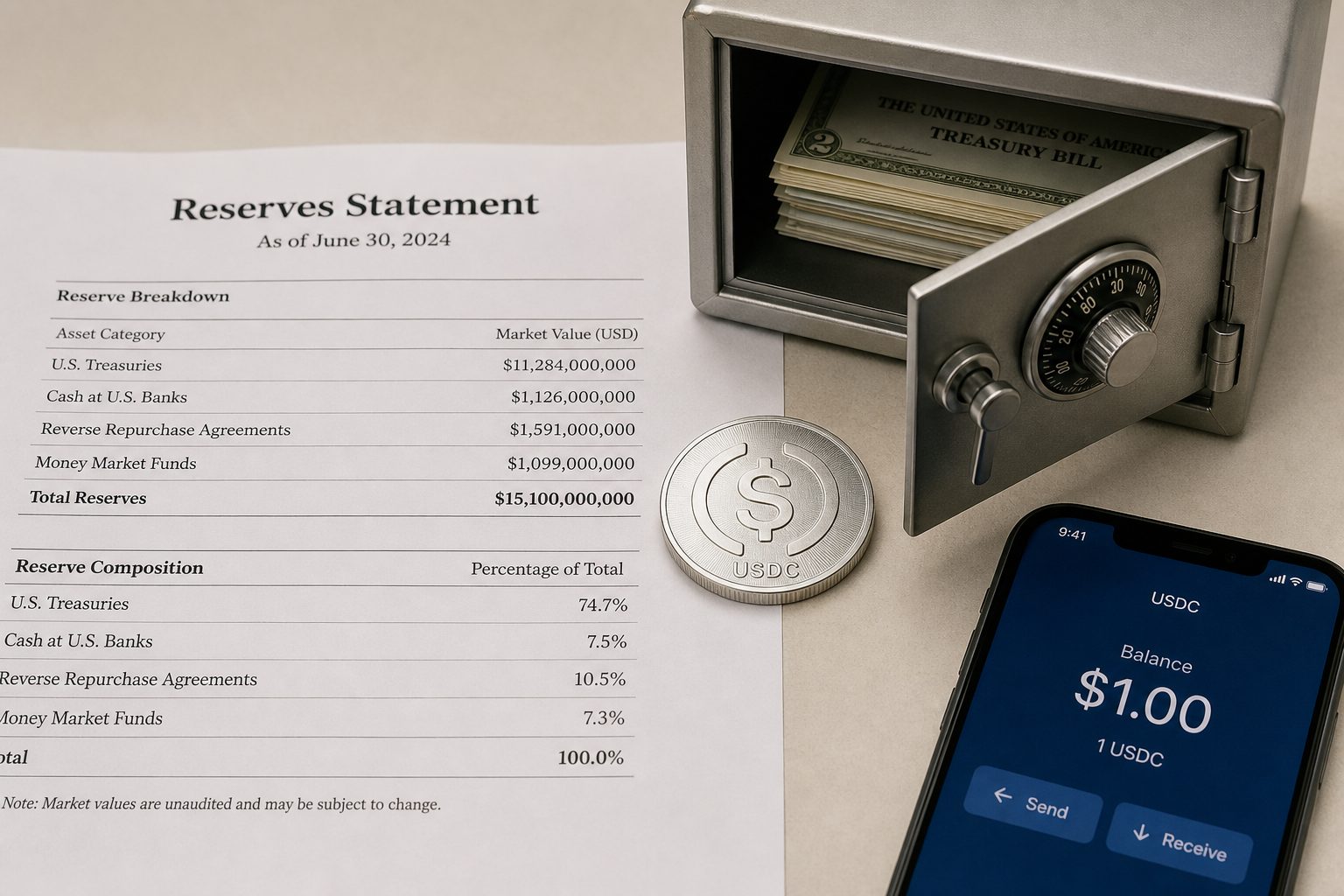
If someone's about to pay you in USDC, spend the next five minutes on one thing: open Circle's transparency page and look at the latest reserve breakdown and attestation date. It takes less time than reading this page, and it's the single habit that tells you whether the dollar-pegged token in your wallet is actually backed by something real right now, not six months ago.
who actually issues USDC
USDC is issued by Circle, a US financial technology company that went public on the NYSE in June 2025 under the ticker CRCL. Circle is not a bank. It's a regulated payment stablecoin issuer, which means every USDC token in circulation is supposed to be matched, one for one, by a dollar of reserves that Circle holds on your behalf and can be redeemed on demand.
what backs each token
The reserves sit in two places. Roughly 20% is cash held in accounts at regulated US banks. The rest, around 80%, sits in the Circle Reserve Fund, an SEC-registered government money market fund managed by BlackRock and custodied at BNY Mellon. That fund holds short-dated US Treasury bills and Treasury-backed repurchase agreements, nothing exotic, nothing tied to Circle's own balance sheet or to crypto markets. The fund also files daily portfolio holdings with the SEC, so the underlying Treasury positions are a matter of public record, not a company's word.
That structure matters because it's the opposite of how a lot of tokens work. USDC isn't collateralized by other crypto assets, and it isn't propped up by a trading algorithm. It's backed by cash and government debt, full stop.
the monthly attestations, and what they don't prove
Circle publishes a monthly attestation from Deloitte & Touche confirming that the reserve total matches the USDC in circulation on a given date, and it now breaks down the composition in more detail than it used to, including cash versus Treasuries and the fund's holdings. Worth being precise about the word: an attestation is a signed agreed-upon-procedures report, not a full financial audit. It confirms the numbers on that specific day. It doesn't guarantee anything about tomorrow, and it doesn't examine Circle's broader finances the way a full audit of the company would. If you're moving meaningful sums through USDC, it's fair to want a full audit eventually. For now, monthly attestations are the standard across the industry, and USDC's are more detailed than most competitors'.
regulated stablecoin versus algorithmic stablecoin
This distinction is the one that actually matters for safety, more than any single fee or exchange listing. A regulated, fiat-backed stablecoin holds real dollar assets you can point to. An algorithmic stablecoin tries to hold its peg through code and a second token instead of collateral, and history has already shown how that ends.
| Type | Example | What backs the peg | Failure mode |
|---|---|---|---|
| Fiat-backed, regulated | USDC | Cash and short-dated US Treasuries, held 1:1 | Bank or custody risk, not collapse of the peg mechanism itself |
| Algorithmic, undercollateralized | TerraUSD (UST), collapsed May 2022 | A sister token (LUNA) absorbing volatility, no real reserves | Peg broke, market cap went from roughly $18 billion to under $1 billion in days |
UST's collapse wiped out tens of billions in value because there was never a dollar sitting behind each token, just a second token designed to expand supply when confidence dropped. That's structurally different from USDC, where every token is a claim on cash and Treasuries you can trace through the monthly reports.
the honest risk: USDC is not FDIC insured
This is the part worth saying plainly instead of glossing over. USDC itself is not an FDIC-insured product. FDIC insurance can apply to the bank deposits that make up part of Circle's reserves, if those deposits sit at an insured institution, but it does not cover the USDC tokens you hold. If Circle itself became insolvent, or if a bank holding reserve cash failed, you'd be relying on the reserve structure and Circle's redemption process, not a federal deposit guarantee.
This isn't hypothetical. In March 2023, USDC briefly lost its peg and traded as low as $0.87 after Circle disclosed that $3.3 billion of its reserves sat at Silicon Valley Bank, which had just failed. The peg recovered once regulators guaranteed SVB depositors, but for a couple of days, a "safe" regulated stablecoin traded well below a dollar. It's the clearest real-world reminder that "backed by cash and Treasuries" still depends on which bank is holding the cash.
The regulatory picture is also still moving. The federal GENIUS Act, the first dedicated US stablecoin law, was signed in 2025 (we explain what the GENIUS Act changes for creators separately), and regulators including the FDIC and OCC have been writing the implementing rules through 2026, with issuer requirements taking full effect in 2027. Those rules are expected to formalize reserve and disclosure standards, but they still don't extend deposit insurance to the stablecoin itself.
where this fits if you're getting paid this way
If you're a creator receiving USDC tips or payouts, this is worth understanding once and then not obsessing over. Meta, for instance, now pays some creators directly in USDC through Stripe, and that program is a good example of how mainstream this rail has become. If you'd rather receive tips directly without any platform in between, a non-custodial tip jar generator lets you generate a payment link tied to your own wallet address, so nothing sits with a third party at all before it lands with you. And if you run a website rather than a creator page, USDC and the same underlying payment infrastructure are also showing up on the other side of the ledger, in how site owners are starting to charge AI crawlers for access.
My honest take: USDC is about as boring and well-documented as a dollar-pegged crypto asset gets, and boring is exactly what you want here. I'd rather hold something backed by Treasuries and checked monthly than something backed by a second token and a hope. But "regulated" isn't the same as "insured," and the SVB weekend proved that a good reserve structure can still wobble if the wrong bank has a bad week. Read the attestation before you rely on it, the same way you'd check any other institution holding your money.
Quick answers
- What backs USDC?
- Circle states that USDC is backed by cash and short-term US Treasuries, with attestations. It is a claim on those reserves, not a government dollar.
- Can USDC go to zero?
- It is designed to stay near $1. Depegs have happened briefly in stress. Read the current attestations, not a slogan.
- Is USDC the same as a bank balance?
- No. It is a token on a blockchain. You still need a wallet or an exchange to hold it and a way to cash out.