USDC or Bitcoin for tips: which should you use
Updated August 6, 2026
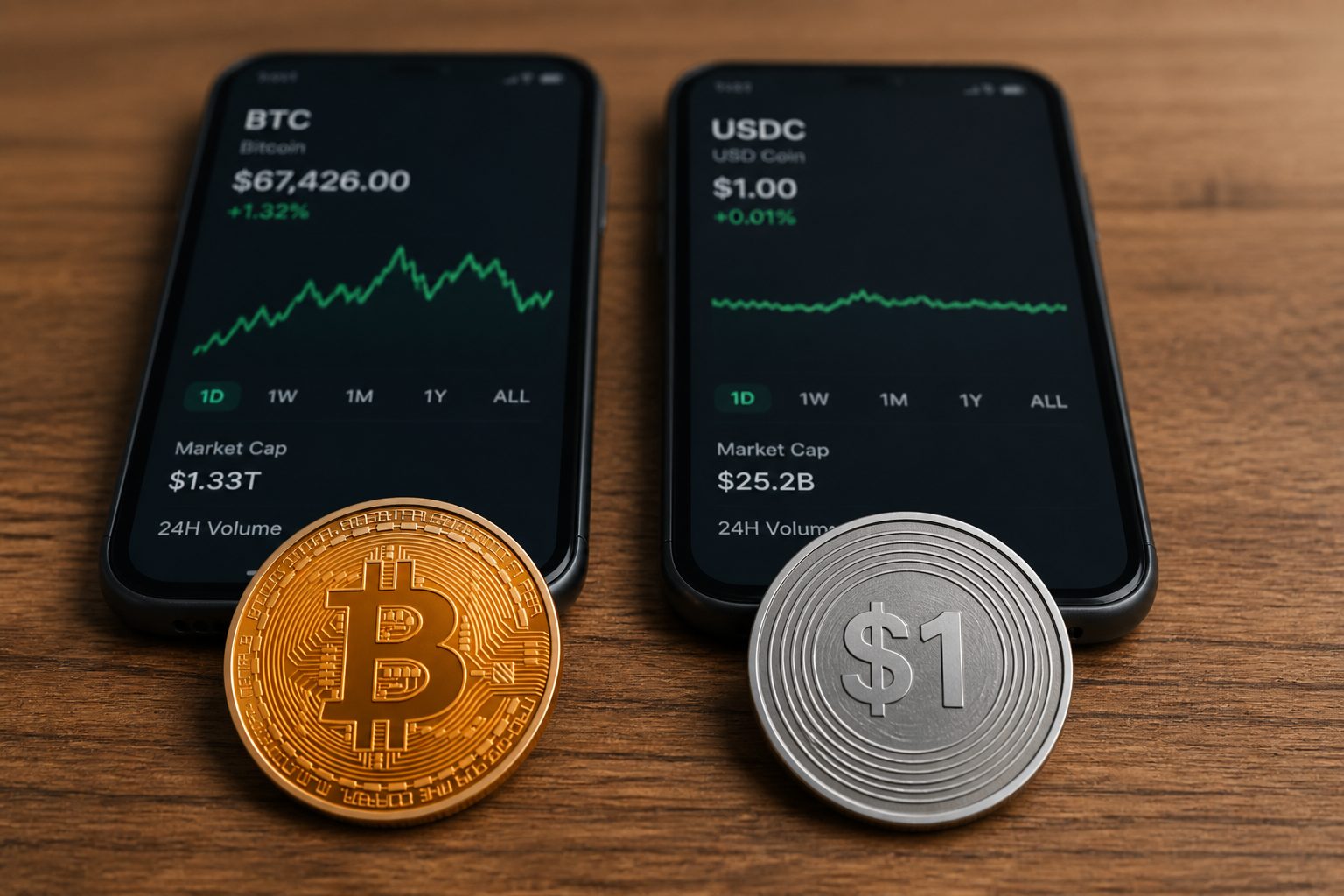
crypto tips are all equally jumpy, so if you accept them at all, you're gambling on price swings every time a fan hits send. That's only true if you default to Bitcoin without thinking about it. USDC, a dollar-pegged stablecoin, was built specifically so a $5 tip is still worth $5 an hour, a day, or a month later. The two aren't interchangeable, and picking the wrong one for the wrong purpose is where most creators get tripped up.
Both run on public blockchains, and both can land in a wallet you control in seconds. That's roughly where the resemblance ends. One holds a fixed price against the dollar. The other floats with the market. Which matters more depends on what you're actually trying to do with the money.
USDC: built to be boring, on purpose
USDC is issued by Circle and pegged one to one with the US dollar, backed by cash and short-term treasuries that get audited monthly. A tip of 5 USDC is 5 dollars today and, barring a rare depeg event, 5 dollars next week too. That predictability is the entire point for anyone using tips as part of a real income, not a speculative side bet.
Fees are the other reason USDC wins for small amounts. On Solana, a USDC transfer typically costs somewhere between half a tenth of a cent and half a cent, small enough that it barely registers against a $1 tip. On Polygon, fees stay well under a cent per transfer, and Polygon has become the busiest USDC network by volume, handling more than half of all USDC transfers globally as of this spring. Both networks settle in a couple of seconds.
This is also the rail Meta chose. Since late April 2026, Meta has been paying eligible creators in USDC through Stripe, settling on Polygon and Solana, rolling out country by country. If you want the full detail on eligibility and how the payouts land, that's covered on the Meta USDC payouts page. The short version: a major platform picked the stable option for the same reason independent creators should consider it, nobody wants their payout to swing while it sits in a wallet waiting to be spent.
Bitcoin and Lightning: a different job entirely
Bitcoin's price can move several percent in a single day. For long-term holders that's just part of owning it. For someone trying to predict this month's income from tips, it's a real problem. A $10 tip in Bitcoin could be worth $9 or $11 by the time you convert it, and you have no control over which.
What Bitcoin still has going for it is recognition. Almost everyone who has ever touched crypto owns some Bitcoin, or at least knows what it is. Some fans will only tip in BTC because it's the coin they already hold, and turning that support away over a fee difference of a few cents seems like a bad trade.
The fee difference matters more on Bitcoin's base layer than people expect. An on-chain Bitcoin transaction has run anywhere from around $1.20 to $8.50 in 2026 depending on how busy the network is, sometimes more during congestion. That eats a $2 tip entirely. The fix is the Lightning Network, a payment layer built on top of Bitcoin that settles in under a second and typically charges routing fees of a few satoshis, often under a cent total regardless of the amount sent. Lightning technically supports payments as small as a single satoshi, which makes it the only sane way to accept small Bitcoin tips.
Getting set up takes an extra decision most people skip: which wallet. Wallet of Satoshi is the easiest on-ramp, custodial and built for beginners, fine for tipping and small balances. Strike leans more toward a fiat-to-Bitcoin bridge and requires identity verification. Neither is wrong, they're just different tradeoffs between convenience and control, the same tradeoff you're making with the asset itself.
the numbers side by side
| Option | Typical fee on a small tip | Settlement time | Value a week later |
|---|---|---|---|
| USDC on Solana | Roughly $0.0005 to $0.005 | A few seconds | Same dollar amount |
| USDC on Polygon | Under $0.01 | A few seconds | Same dollar amount |
| Bitcoin, on-chain | $1.20 to $8.50, more when the network is congested | Minutes to hours | Whatever BTC is worth that day |
| Bitcoin, over Lightning | Usually a fraction of a cent in routing fees | Under a second | Whatever BTC is worth that day |
None of this predicts where Bitcoin's price goes next, and nobody honestly knows. That's not the question a creator needs answered anyway. The real question is which asset lets you plan around what a tip is worth the moment it arrives, and only one of these two does that reliably.
what to actually set up
For most creators, USDC should be the default option people see first: stable, cheap to move, and increasingly familiar since platforms like Meta are already paying creators in it. Add Bitcoin over Lightning as a second option for fans who prefer it, rather than the main event. Both can be set up without handing your funds to a middleman: the tip jar generator builds a QR code and payment link straight from an address you already control, nothing is custodied, and you can list a USDC address alongside a Lightning address on the same page.
If you also run a blog, newsletter, or any site that gets crawled, the same instinct toward stable, low-friction payment rails applies on the other side of the ledger too. Cloudflare's default is flipping to blocking unpaid AI crawlers on September 15, 2026, and site owners who'd rather charge than block are looking at x402, a stablecoin-based payment standard built on the old HTTP 402 status code. That story, including who's backing it, is laid out on the AI crawler payments page.
The rule: use USDC for anything you plan to spend soon, and treat Bitcoin tips as a welcome bonus, never as the paycheck you're counting on.
Quick answers
- Is USDC or Bitcoin better for tips?
- USDC stays near one dollar and is cheap on Solana or Polygon. Bitcoin is more widely recognised; Lightning is the cheap Bitcoin path.
- Why not on-chain Bitcoin for $2 tips?
- The fee can eat the tip. Lightning or a cheap USDC network is usually better for small amounts.
- Can I offer both?
- Yes, if you label each QR. Two unlabelled addresses is how people send the wrong asset.