USDC vs USDT: what creators should know about the difference
Updated August 6, 2026
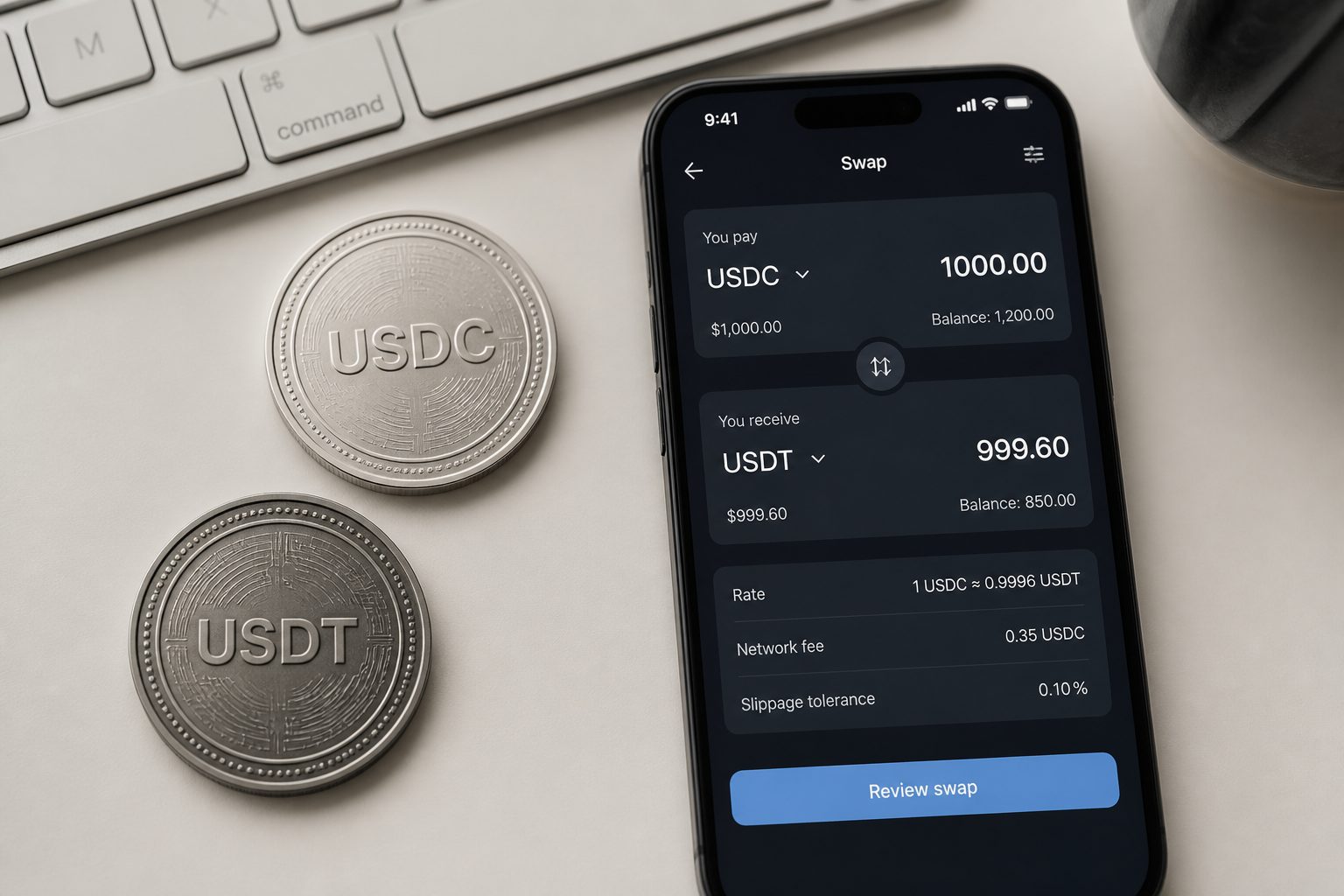
USDC is audited more often and more transparently. USDT is held and spent more widely around the world. That's the one practical difference that matters most for creators: audit rigor against real-world reach. These two coins are not interchangeable once money actually needs to move across borders, platforms, or accounting software, and the gap between them is bigger than anything you'd see on a price chart.
Both are dollar-pegged tokens built to hold a value of $1.00. Both trade in the billions every day. But they come from different companies, get checked in different ways, and land in different corners of the world. If you take tips or invoice clients in stablecoins, that difference matters more than which one happens to be bigger.
Who actually stands behind each coin
USDC is issued by Circle Internet Group, a US company that went public on the New York Stock Exchange in June 2025. Circle publishes a monthly attestation of its reserves, reviewed by Deloitte, one of the Big Four accounting firms that has audited Circle's financials since 2022. Circle also discloses its reserve holdings weekly. Most of that backing sits in the Circle Reserve Fund, an SEC-registered money market fund holding cash, short-dated US Treasuries, and overnight repurchase agreements. In July 2026, Circle received approval from the Office of the Comptroller of the Currency to run a national trust bank, another step toward operating inside the US banking system rather than alongside it.
USDT is issued by Tether, a company that moved its headquarters to El Salvador in January 2025. Tether publishes quarterly attestations, prepared by BDO Italia, rather than a full annual audit. Its reserve mix is wider than Circle's: alongside Treasury bills and cash equivalents, Tether's reports have included corporate bonds, secured loans, precious metals, and a bitcoin position, with custody partly handled through Cantor Fitzgerald. None of that means the reserves are inadequate. It means the composition is more varied and reported less often, and that's the real, checkable difference here, not a rumor.
Tether has also built a separate product for the tighter US regulatory environment created by the GENIUS Act, the federal stablecoin law passed in 2025. That token, USAT, launched in September 2025 under its own US-based leadership. USDT itself, the coin you'll actually be paid in day to day, still operates mostly outside that US framework. Circle, by contrast, built its entire US business around fitting inside it.
Where each one actually gets used
USDT is the bigger coin by circulation, with a market cap around $183 billion as of early August 2026, against roughly $72 billion for USDC. Size alone doesn't tell you where the money moves, though. USDT dominates trading volume on exchanges serving Latin America, South and Southeast Asia, and parts of Africa, and it's the default settlement token on the Tron network for a lot of cross-border and peer-to-peer transfers. If your audience or client base sits mostly in those regions, chances are they already hold USDT and would rather send it than convert to something else first.
USDC leans the other way: heavier use on US-regulated platforms, on Coinbase, and on newer payment rails built by companies trying to stay inside US and EU compliance rules. That's part of why Meta chose USDC, not USDT, when it started paying some creators directly in stablecoins through Stripe on Polygon and Solana, a rollout we cover on our Meta USDC payouts page. It's also the coin most commonly reached for in early builds of x402, the HTTP-based payment standard now backed by Visa, Mastercard, Amex, Stripe, and Google, which we walk through on the page about getting paid when AI reads your site.
| USDC | USDT | |
|---|---|---|
| Issuer | Circle Internet Group (public, NYSE) | Tether International (HQ in El Salvador) |
| Reserve check | Monthly attestation, Deloitte | Quarterly attestation, BDO Italia |
| Reserve mix | Mostly cash and short-term US Treasuries | Treasuries plus bonds, loans, metals, bitcoin |
| Market cap (Aug 2026) | ~$72 billion | ~$183 billion |
| Strongest regions | US, EU, regulated fintech rails | Latin America, Asia, Africa, Tron network |
| US regulatory fit | Built for GENIUS Act compliance | Separate token (USAT) built for that; USDT itself sits outside it |
Practical guidance, not a verdict
Neither coin is "better" for every creator. If most of your tips or payments come from the US or Europe, or you're getting paid through a platform like Meta's payout system, USDC is probably already the path of least resistance. If your audience skews toward Latin America, South Asia, or the Gulf, USDT may already be what people are holding and willing to send, and asking them to buy USDC instead adds friction and sometimes an extra conversion fee.
The safest approach is to accept both and let your fans or clients pick. If you set up a wallet with our tip jar generator, you paste in your own USDC and USDT addresses directly, nothing is custodied on our end, and you decide later, coin by coin, when and how to move or convert the balance. Keep the two separated in your own records too. Mixing them in one spreadsheet line makes tax season harder, not easier, and if you ever need to explain a transaction to a bank or an accountant, "USDC from Circle" and "USDT from Tether" are two different paper trails.
One more habit worth building: check the attestation reports occasionally, not because you need to become an auditor, but because the frequency and depth of those reports is the one thing that's genuinely improved over the past couple of years, and it's a habit that rewards the issuer that keeps improving it.
What's likely still true in six months: USDC will keep publishing monthly, Deloitte-reviewed reserve reports, and USDT will keep being the larger, more globally spread coin with a quarterly check-in. What could change is the regulatory gap between them. With the GENIUS Act now shaping how US-facing stablecoins operate, and Tether building USAT specifically to fit inside that framework, the rules about which coin you can use for which client, in which country, are more likely to shift over the next six months than the coins' basic mechanics are.
Quick answers
- What is the difference between USDC and USDT?
- Both target one US dollar. USDC is issued by Circle with published reserves. USDT is issued by Tether and is more widely listed in some markets.
- Which should a creator take?
- Match what your audience and payout rail already use. Meta-style rails have been settling USDC, not USDT.
- Are they the same token on every chain?
- No. Each network has its own contract. Sending USDT on Ethereum to a Solana USDC address will not land.